Indian Winters on a Plate
Pull up a chair, take that first bite, and let India’s winters introduce themselves to you, one dish at a time.

Written by
Harshita Keswani
Published on
November 21, 2025
India is a kaleidoscope with a wide ranging variety of cultures existing within one country. And I’d be lying if I said that this variety is not reflected in its food. Indians love their food. A lot of daily conversations in India are around food. Men gather around at the local tea shops after their morning walks, mothers asking their children what they’d like to eat for the next meal, two colleagues spending half an hour deciding the flavour of the samosa that they’d like to eat for a snack. Food is an integral part of Indian life. If you walk into a room that’s serving Indian food, you’re likely to find it filled with the aroma of spices, cauldrons full of fragrant curries, the smell of tandoor and a blastful of flavours in one’s mouth.
In the land of Ayurveda, the food that Indians eat also varies from season to season and from region to region. In summers, for example, most regions would prefer to have foods that support hydration. During the rains, warm, spicy, and fried foods gain popularity within the households. In winters, homes are bathed in the smell of warm spices and with winters being around the corner, here are some foods that you must try this season.
Sarson ka Saag

Paired with makki ki roti, white butter and jaggery, this is the go-to winter meal for North Indians, especially people residing in the Punjab belt. Originally known as the staple food of the Punjabi farmers, sarson ka saag is a powerhouse of calcium and iron. The hearty, slow-cooked greens, glistening with a drizzle of ghee, arrive at the table in a rustic, steaming bowl that instantly warms the senses. Its velvety texture and mildly bitter, earthy notes are perfectly balanced by the sweetness of jaggery and the comforting blandness of makki ki roti. Each bite feels robust and satisfying, leaving a lingering warmth and a hint of spice at the back of your throat, like a cosy embrace on a foggy winter morning.
Gajar ka Halwa

When you start seeing huge black kadhais filled with grated carrots being dunked in litres of milk and bowls of sugar, you know that this winter season in North India has arrived. The advent of this delicious slow cooked dish is credited to the Dutch. While halwas were always popular in India since the times of the Mughals, gajar ka halwa only came into being when the Dutch bought orange carrots that were indigenous to Afghanistan, to India during the 17th century.
Nalli Nihari

Enter the narrow bylanes of Old Delhi in winters and you’ll be welcomed with dense white fog in the air, along with the aromatic smell of Nalli Nihari. While not many of us really prefer having something as heavy as mutton as our first meal, Old Delhi’s Nalli Nihari deserves a sure shot spot on your breakfast plate. Nihari is a slow cooked mutton curry, wrapped in spices, especially pepper. It is cooked for about 3-4 hours, to tenderize the meat and is usually eaten with Khamiri Roti, a thick fluffy bread. Nihari first originated in the royal kitchens of India during the Mughal era before it gained layman popularity in the regions of Delhi and Lucknow. It was served as a high-protein breakfast for the Mughal army. The word “Nihari” is derived from the word “Nahar”, which literally translates to “morning” in Arabic.
Bajre ki Roti with Lasun Chutney & Ghee
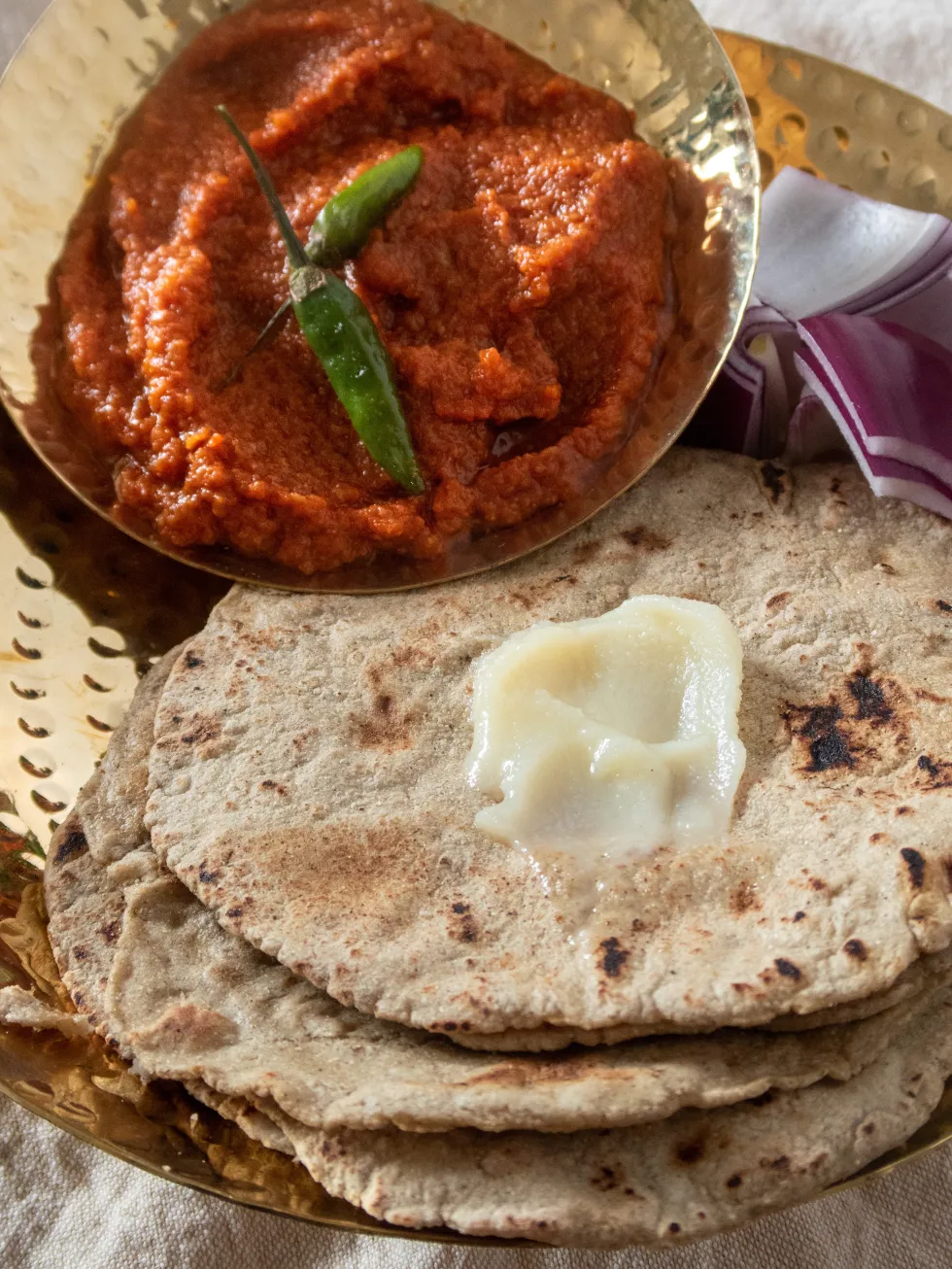
In the land of survival, amidst the eternal sand dunes of Rajasthan, where survival is a harsh test for man, animals and crops alike, there is one crop that thrives – Pearl millet, or Bajra. This crop has been the staple diet for rural folk of Rajasthan for centuries. Accompanied by garlic or lehsun chutney, grounded in stone, this roti is patted out by hand, often clapping it between palms. The spicy chutney generates heat in the body and provides protection against the harsh desert winters of Rajasthan.
Matar ka Nimona

As winter dawns in the northern state of UP, the markets begin flooding with lush green peas and matar ka nimona finds its place in the lunch and dinner menus of families. Unlike the meats and kebabs of Lucknow, that were born in the royal kitchens, matar ka nimona is truly a dish of the people. It is served with warm rotis in traditional gatherings and is truly an underrated dish that one must try.
Undhiyu

Slow cooked in inverted earthen pots, undhiyu, which means “upside-down” in Gujarati, is a popular dish that originated in South Gujarat. It is made with a variety of seasonal vegetables like surti papdi, brinjals, and sweet potatoes, along with spiced fenugreek dumplings called methi muthiyas. Traditionally, this mixed vegetable stew was cooked in communal clay-oven pits that enhanced the flavor and reflected pre-industrial cooking methods. It’s associated with the winter harvest festival of Uttarayan (Makar Sankranti), where it is served in homes as families gather for kite flying. The dish is so popular that the day of Makar Sankranti in Gujarat is also known as National Undhiyu Day.
Nolen Gur

For nearly 200 years, a mithai shop named Nalin Chandra Das & Sons has been brightening the quiet lanes of Kolkata with the woodsy, vanilla-like aroma of Nolen Gur, a liquid or solid jaggery made from the sweet sap of date palms. Artisans belonging to a caste known as Siulis were the first ones to extract the sap of this tree. Over the years, nolen gur has found its place in roshogullas, sandesh, kancha golla, payesh and many popular Bengali dishes.
Thukpa

The snow-draped valleys of the Himalayas have a hearty, warm secret that they’ve inherited from the refugees of Tibet – Thukpa. Over the years, this humble dish has become an integral part of the culinary heritage of Sikkim, Assam, Arunachal Pradesh, Nagaland, Ladakh and Himachal Pradesh, binding these regions with a common bowl of comfort. In cold climates, Thukpa is the foremost comfort food, providing instant warmth, energy and comfort. It is also a staple in many mountain villages, where locals cook a flavourful broth along with noodles as part of their everyday meals. As it travelled across the mountains, Thukpa adapted to local tastes, resulting in distinct regional variations. In Sikkim, it is served with dumplings or momos. In Arunachal Pradesh, a special version called Putang Thukpa is popular as it uses hand-pulled buckwheat noodles (locally grown at high altitude) cooked in a curry-like broth. Further north in Ladakh, Thukpa is enjoyed with hand-pulled noodles or dry noodles served alongside a rich meat curry, making it especially hearty for the harsh winters. And in Darjeeling and North Bengal, this is made by simmering mutton bones to create a rich stock, then adding noodles, shredded greens and a dollop of smoked chili chutney, with spring onion as an essential garnish that brightens the bowl.
Hanhor Mangxo Komora

As underrated and mesmerizing as the state of Assam, Hanhor Mangxo Komora, an Assamese Duck Curry with Ash Gourd, is a rich, hearty duck stew that is long regarded as a festive delicacy. Though it is traditionally prepared during festivals like Bihu, it is a must try if you’re visiting the state of Assam. Slow-cooked in its own fat with warming spices, the duck turns unbelievably tender, while the ash gourd soaks up all those deep, peppery juices, adding a delicate sweetness that lightens every bite. The result is a bowl of comfort that’s bold and balanced, leaving you with a lingering warmth and a flavour that you’ll find yourself craving long after you’ve left Assam.
So this winter, if you find yourself reaching for something familiar, maybe pause and look a little further, into another state, another kitchen, another story. Somewhere, a pot is bubbling, a kadhai is sizzling, and a family is gathering around a meal that has been loved for generations. All you have to do is pull up a chair, take that first bite, and let India’s winters introduce themselves to you, one dish at a time.